
|
Troubleshooting
tips for Spark Plug type heaters.
Spark Plug Type Heater Principle
In a perfect
operational Spark Plug type heater:
- Plug the unit in. Occasionally, activation of the
reset button on the Safety Control will be required.
- When the motor starts to turn, the fan blows air
through the combustion chamber, the fuel begins to flow, because the air
pump (rotor) is directly connected to the motor shaft. Air is delivered
to the nozzle adapter by the air pump at a precise pressure. At the
nozzle adapter, the passing air creates a venturi effect, sucks fuel
from the tank and thereby delivers fuel to the nozzle at a precise
fuel/air rate for atomization. IMPORTANT: An incorrect air pressure rate
at the nozzle will create an incorrect rate of fuel delivery at the
nozzle. Instructions for setting the pump pressure are at
http://reddyparts.com/pressure.htm .
- The Ignition Device (transformer – old name)
immediately produces a spark across the spark plug.
- The photocell starts looking for a flame in the
chamber.
- IF the COMPLETE system is performing to factory
specs then there is combustion.
- The spark plug produces a spark continuously.
- The photocell takes over and monitors the flame.
If the photocell loses sight of the flame, it signals the Safety Control
to shut the heater down by tripping the reset.
- If the system is performing properly, the heater
should be operational until out of fuel or the power is disconnected.
“My heater runs for 30 seconds and
shuts down” is the most common question I am asked. Listed below are
some of the more obvious troubleshooting tips:
-
If you brought the
heater to our shop we would immediately check the pump pressure.
Always-check the pump pressure FIRST. The pumped air eventually sucks
the fuel from the tank. Low pump pressure translates directly to poor
fuel delivery. Loss of only ˝ psi can cause as much as 30% reduction
in fuel delivery (starvation).
-
By performing a pressure
check much valuable time is saved in the troubleshooting process. And,
it’s easy. For instructions visit
www.reddyparts.com/pressure.htm .
-
If there is zero
psi, then the problem is almost certain to be a broken rotor. If there
is “some” pressure then adjust the pressure to specs.
-
If unable to reach
specs, then look for an air leak. If you don’t want to check the air
pressure- then take the heater to someone else to fix, because you will
never make a heater mechanic! (No offense intended.) Correct pressure
is critical. If you don’t have a low pressure (0-15 psi)
gauge order HA1181 or HA1182 or find one locally. Our gauges are
complete. We have accumulated all of the fittings so you don’t have to
go to 3 different stores shopping for the correct components.
-
If there is zero
psi, then the problem is almost certain to be a broken rotor. If there
is “some” pressure, then adjust the pressure to specs. If unable to
reach specs, then look for an air leak, using soapy water.
Stay clear of
electrical components (shock hazard) and the fan blade (knuckle hazard).
-
Next, shine a
flashlight into the fuel tank. Look for water/debris/contamination. Any
of these conditions will produce a flame-out condition causing the
photocell to shut the heater down. Drain & replace the fuel, if
necessary.
-
Check to see if
the sparkplug is sparking. No spark? Check the ignition device (aka
transformer, spark box). Note: the ignition device MUST have a good
ground.
-
Check plug gap. It
should be 60-80 thousandths, about the thickness of a dime.
-
If the sparkplug
is worn on the tip replace it.
-
If all of the
above are ok, REMOVE the spray nozzle, check for obstruction. Use
compressed air (wear eye protection) from the front of the nozzle to
clear.
-
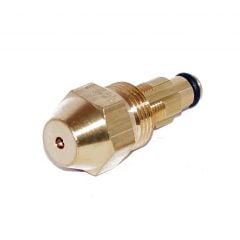
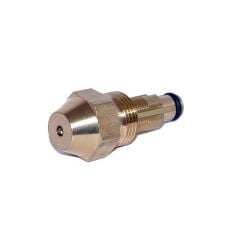
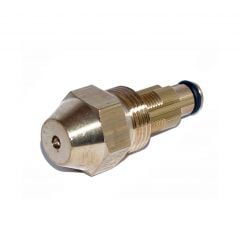
Nozzles don’t last
forever. The hole becomes worn, it then produces a spray instead of a
fog which results in ignition failure. Replace it.
-
The Nozzle is worn.
DESA recommends annual replacement. If the pressure is correct and the
heater fires off & runs with the top cover off, but goes out when the
lid is replaced, then it’s a 90% good bet that the nozzle is worn.
Replace it.
-
The air pump
(rotor) pumps air to the nozzle. In turn, the air sucks fuel from the
tank then the air & fuel mix at the nozzle and creates atomization.
IMPORTANT: if the fuel is sprayed instead of fogged then
incomplete combustion will occur and the photocell will shut the heater
down. If there is an air leak ANYWHERE between the pump and the nozzle
THE PUMP WILL NOT BE ABLE TO ACHIEVE FACTORY SPECIFIED PUMP PRESSURE and
you will NEVER be able to get the heater to run properly! Find the leak
with soapy water and fix the leak, and then set the pressure. If the
fuel filter is restricted or the fuel line is cracked there will be poor
fuel delivery.
-
If all of the
above checks out Ok, then the photocell is either dirty, poorly aimed,
or defective. Test by temporarily bypassing.
Please understand that my recommendation for trouble shooting comes
strictly from the description that has been given to me over the internet.
If your heater was in our shop, I may have a different evaluation of the
problem.
Setting the pump
pressure
Illustration by DESA
International
|
 |
Use 0-15 psi gauge
Part number HA1181
Low pressure gauge
& fittings inserted in the end
cover in order to
set the pump to factory specs.
  |
Locate the
black plastic
end cover that is mounted on the intake end of the motor/pump assembly.
Some end covers are round, some are rectangular. The end cover will have 2 protrusions, 1 long
and one short, and a receptacle that houses the foam air filter.

The long protrusion
houses the pump adjuster (relief valve) which consists of a ball, spring, &
adjustment screw. The ball is inserted first, then the spring, then the
screw w/hole. The purpose of the adjuster is to allow excess air to
escape. If the pump is operating properly the further the screw is run in
the tighter the spring & ball, the higher the pressure. Therefore, if
unable to reach or exceed the pressure required for your heater, then
there is a problem “before” the air reaches the gauge, either the rotor is
defective or there is an air leak (the 2 most likely spots to check with
soapy water are the cork gasket that surrounds the lint filter or possibly
a crack in the black plastic cover itself).
The short protrusion
normally has a solid plug inserted. Remove the plug- insert the gauge.
Turn the adjusting screw
until the required pressure is reached.
Q. What if the pressure
can’t be reached?
A. Using soapy water check for very, lather type, fine
bubbles around the lint filter assembly point and check for a crack(s) in
the black plastic end cover. Stop the leaks and the pressure will come up
provided the rotor & vanes are intact, have the proper gap, and are
functional. And, provided the motor is turning the correct revolutions.
Fact...you
can replace every part on a heater,--- but if the air pump pressure is not
correct....the heater will not run!!
Suggested reading-
SPARK PLUG HEATER FAQ sheet |